





Introducing the InBody 970 Body Composition Analyser
InBody 970 is the world's most advanced BIA body composition scanner. 8 frequencies. 40 impedance measurements. 70 seconds. No radiation. No guesswork.

WHAT is the InBody 970?
The InBody 970 is InBody’s flagship medical-grade body composition analyser, validated in over 8,000 peer-reviewed studies and trusted by NASA, the U.S. military, the NHS, and elite sporting teams worldwide. Get Scanned brings it to your door.
The InBody 970 represents nearly three decades of continuous development in bioelectrical impedance analysis. Built by InBody, a South Korean biomedical technology company founded in 1996 by Dr. Kichul Cha at Harvard Medical School, it is the most advanced standing body composition analyser ever manufactured.
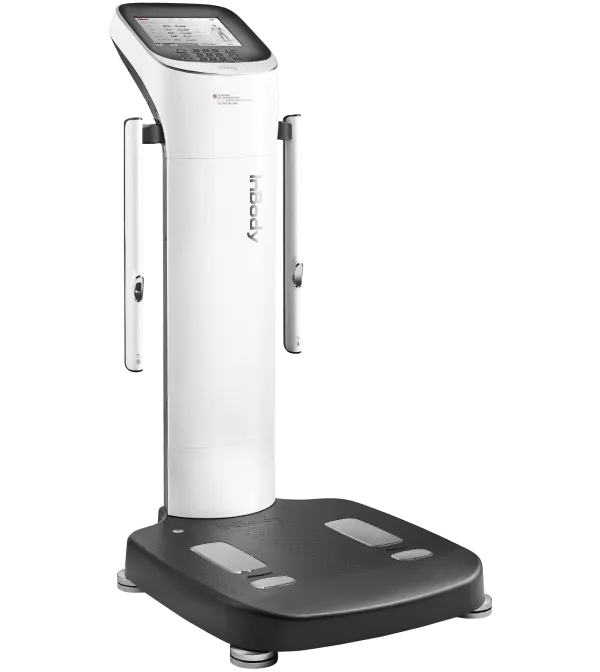
A bathroom scale gives you one number. The InBody 970 gives you over 70 clinical parameters: skeletal muscle mass, body fat mass, total body water, intracellular and extracellular water, visceral fat area, segmental lean and fat distribution, phase angle, body cell mass, and more. Not just how much you weigh. What you’re made of, where it sits, and how it’s changing.
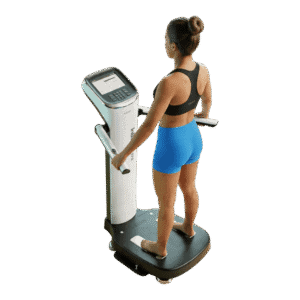
The scan takes 70 seconds. No radiation. No undressing. No hospital appointment. You stand on the device, hold the hand electrodes, and walk away with a comprehensive multi-page clinical report.
HOW the InBody 970 Works
The InBody 970 is built on four technologies that separate it from every other BIA device on the market.
Direct Segmental Measurement
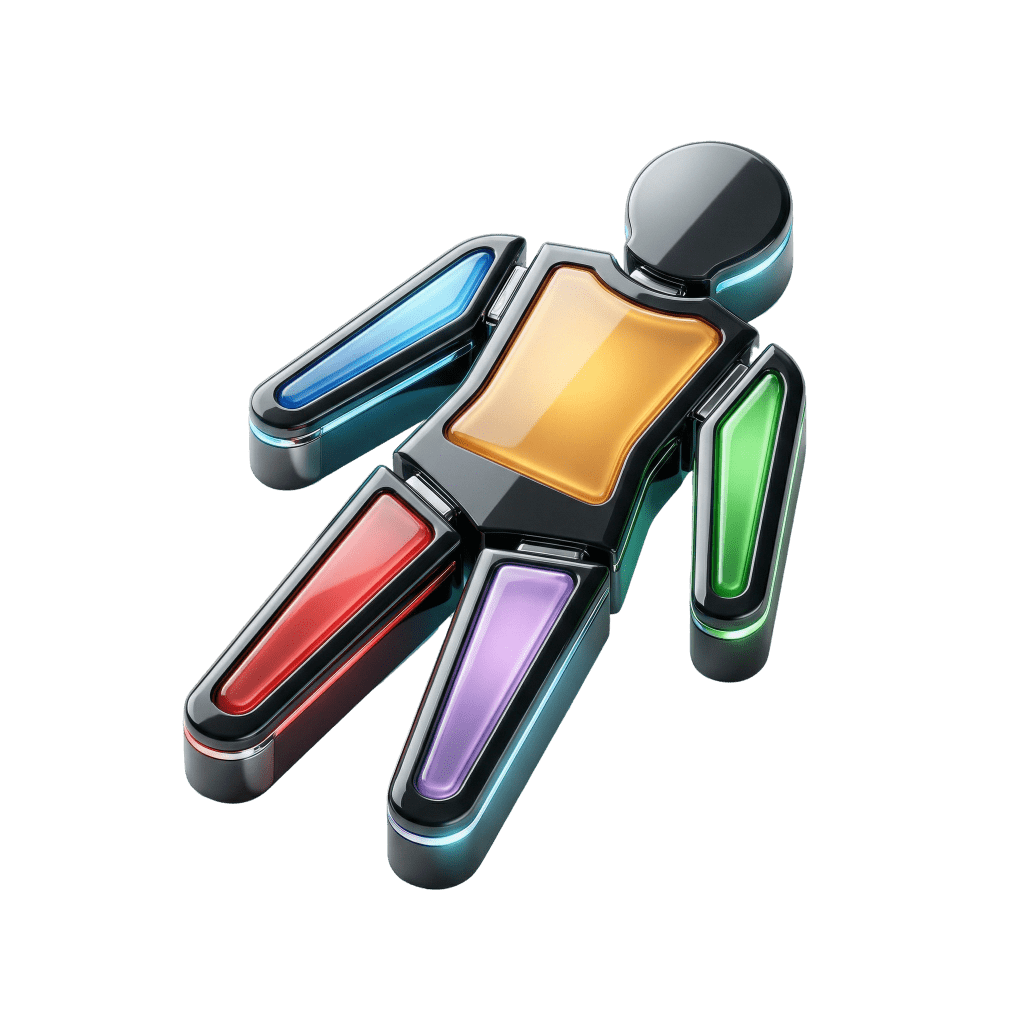
Your body is not one cylinder. Your arms, legs, and trunk are completely different in size, composition, and impedance. The InBody 970 measures all five segments independently, including the trunk, which most competitors cannot do. This is critical because the trunk contains roughly half your lean body mass.
8-Point Tactile Electrode System
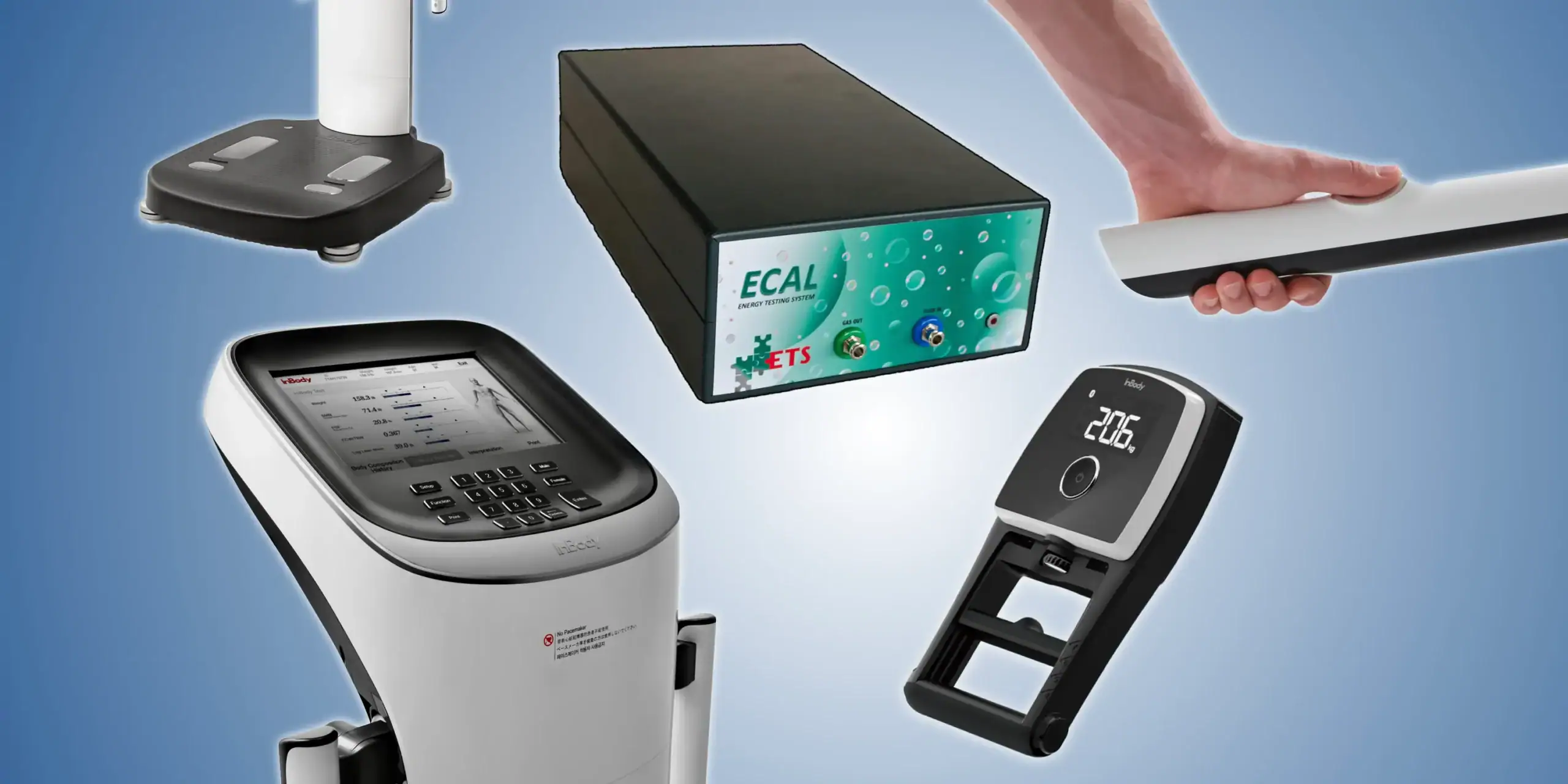
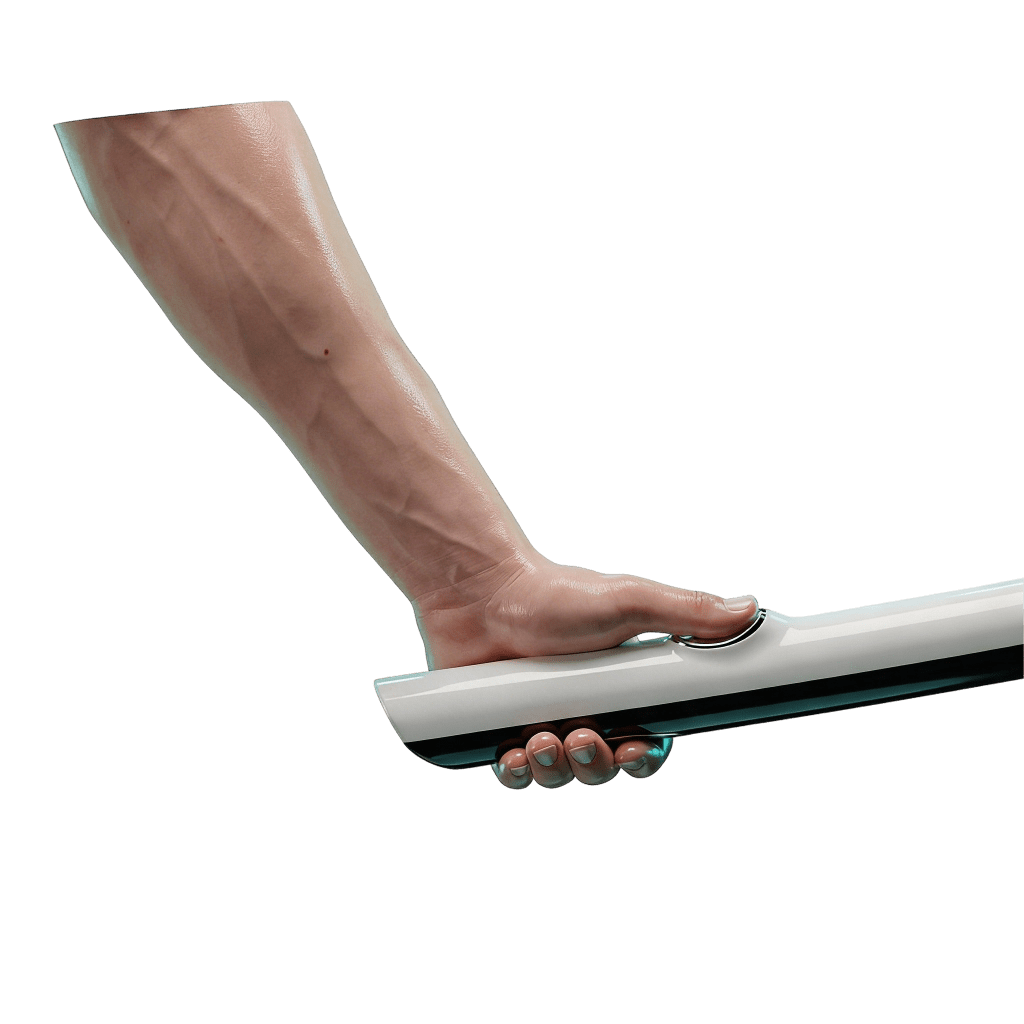
Eight electrodes with patented thumb contacts ensure every measurement starts at the exact same anatomical point: your wrists and ankles. This delivers 99% test-retest reproducibility. You can scan today, scan in six weeks, and know the difference is real.
8 Frequencies from 1 kHz to 3 MHz
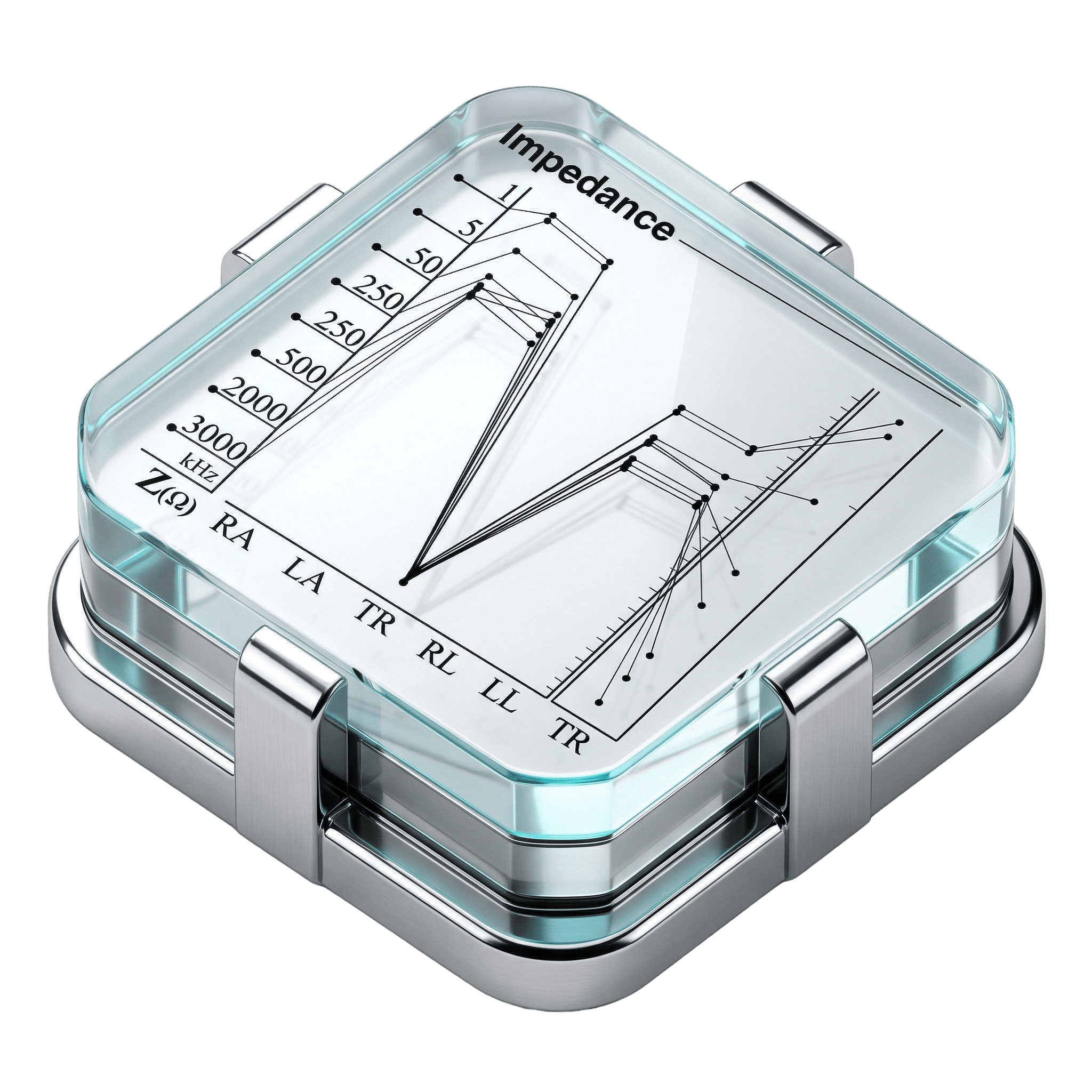
Low frequencies measure water outside your cells. High frequencies penetrate cell membranes and measure water inside them. The InBody 970 uses 8 frequencies across this range, taking 40 separate impedance measurements per scan. The inclusion of 3 MHz makes it the first BIA device in the world to reach this frequency, enabling the most precise separation of intracellular and extracellular water available in any standing analyser.
No Empirical Estimations
This is what matters most. Consumer scales and MOST gym and supplement store scales plug in your age, sex, and ethnicity, then apply population-level assumptions to guess your results. The InBody 970 does not do this. Your results are calculated directly from your measured impedance. Your body. Not a statistical model.

WHAT Makes It Medical-Grade?
The term gets thrown around loosely. Here is what it actually means for the InBody 970.
It is FDA cleared, CE marked, TGA listed, and certified to ISO standards. It uses no empirical estimations in its calculations. It measures each body segment independently at 8 frequencies. It has been validated against DEXA in peer-reviewed studies with a correlation of up to 99% for lean body mass. And it delivers 99% reproducibility between tests, meaning the data is reliable enough to track meaningful changes over time.
Compare that to a consumer BIA scale. Those devices typically use 1 to 2 frequencies, measure your legs only (or arms only), treat your entire body as a single cylinder, and apply age and gender equations to fill in the gaps. If you changed your age in the settings, you would get different results. On the InBody 970, it makes no difference, because your body composition is measured, not estimated.
WHAT the InBody 970 Measures
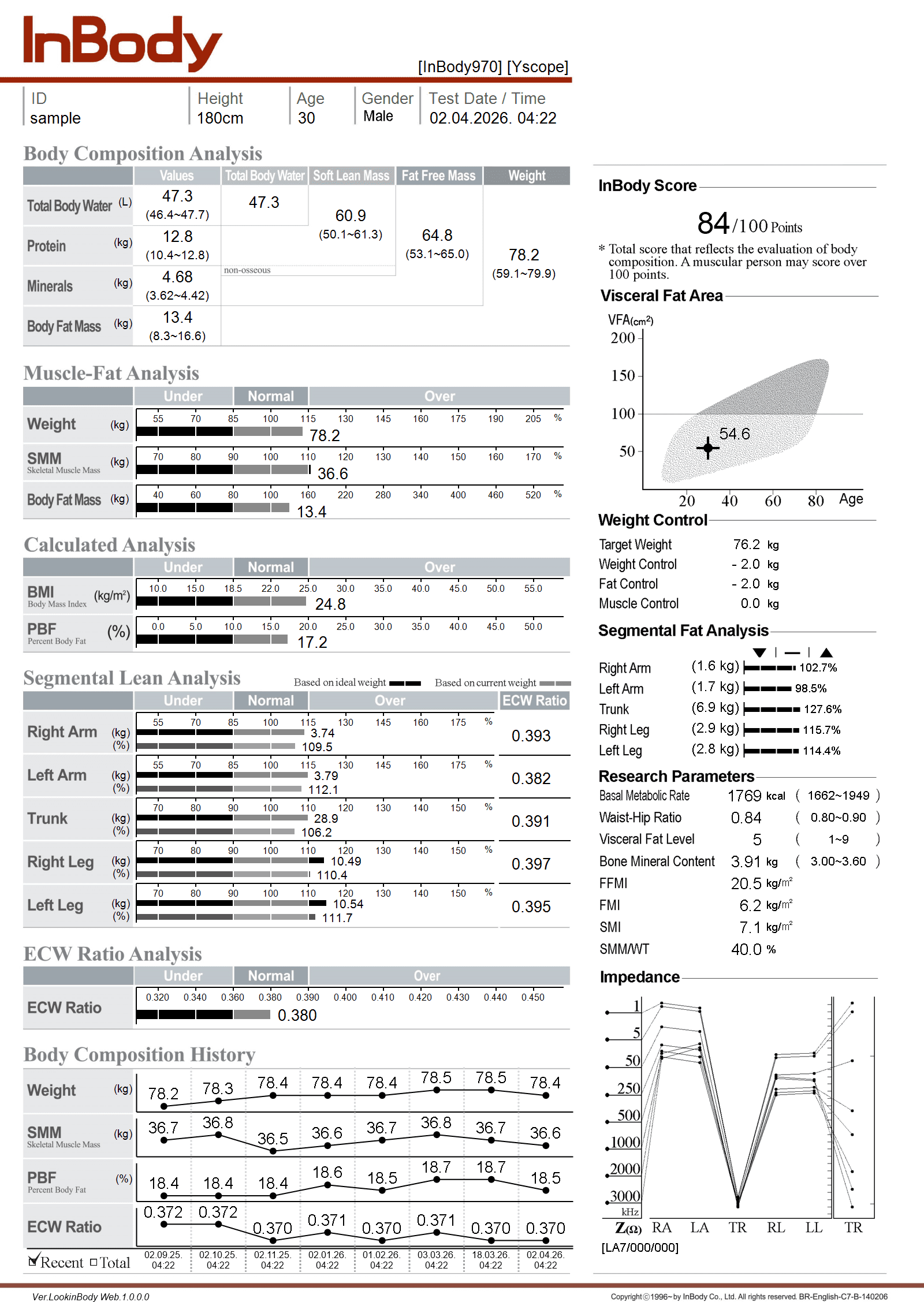
Every InBody 970 scan produces a detailed multi-page clinical report. The specific result sheets we always include are: Body Composition and Body Water. We are also able to produce when needed: Research, Evaluation, Comparison, and a Children’s Report.
Body Composition Result Sheet
Your total body water, lean body mass, body fat mass, skeletal muscle mass, percent body fat, segmental lean analysis (each arm, each leg, trunk), segmental fat analysis, visceral fat area, basal metabolic rate, and body composition history showing changes over time.
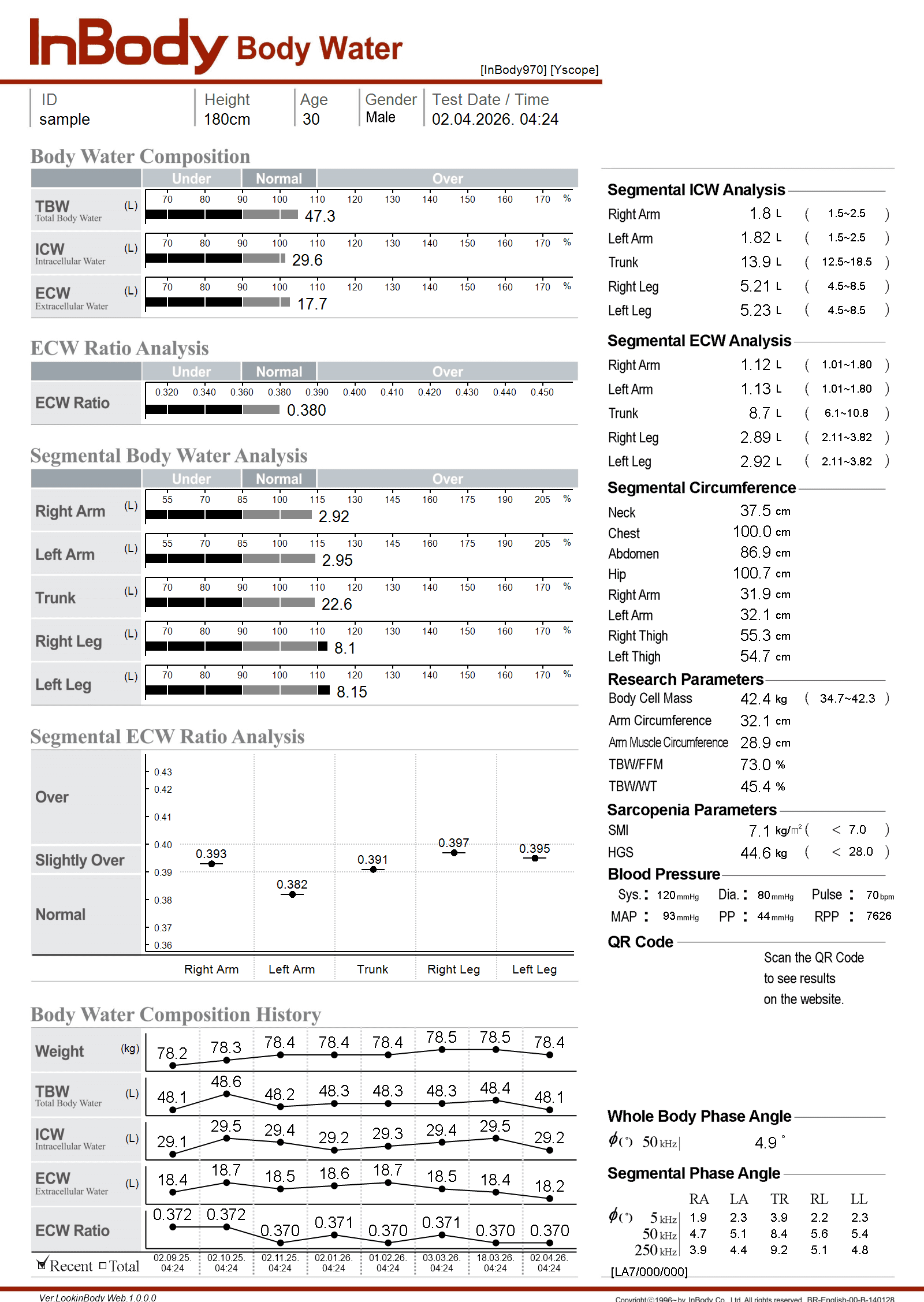
Body Water Result Sheet
Total body water broken into intracellular and extracellular components, with segmental analysis for each limb and the trunk. ECW/TBW ratio identifies fluid imbalances, inflammation, and oedema. This is the data that medical professionals, physiotherapists, and researchers rely on for clinical monitoring.
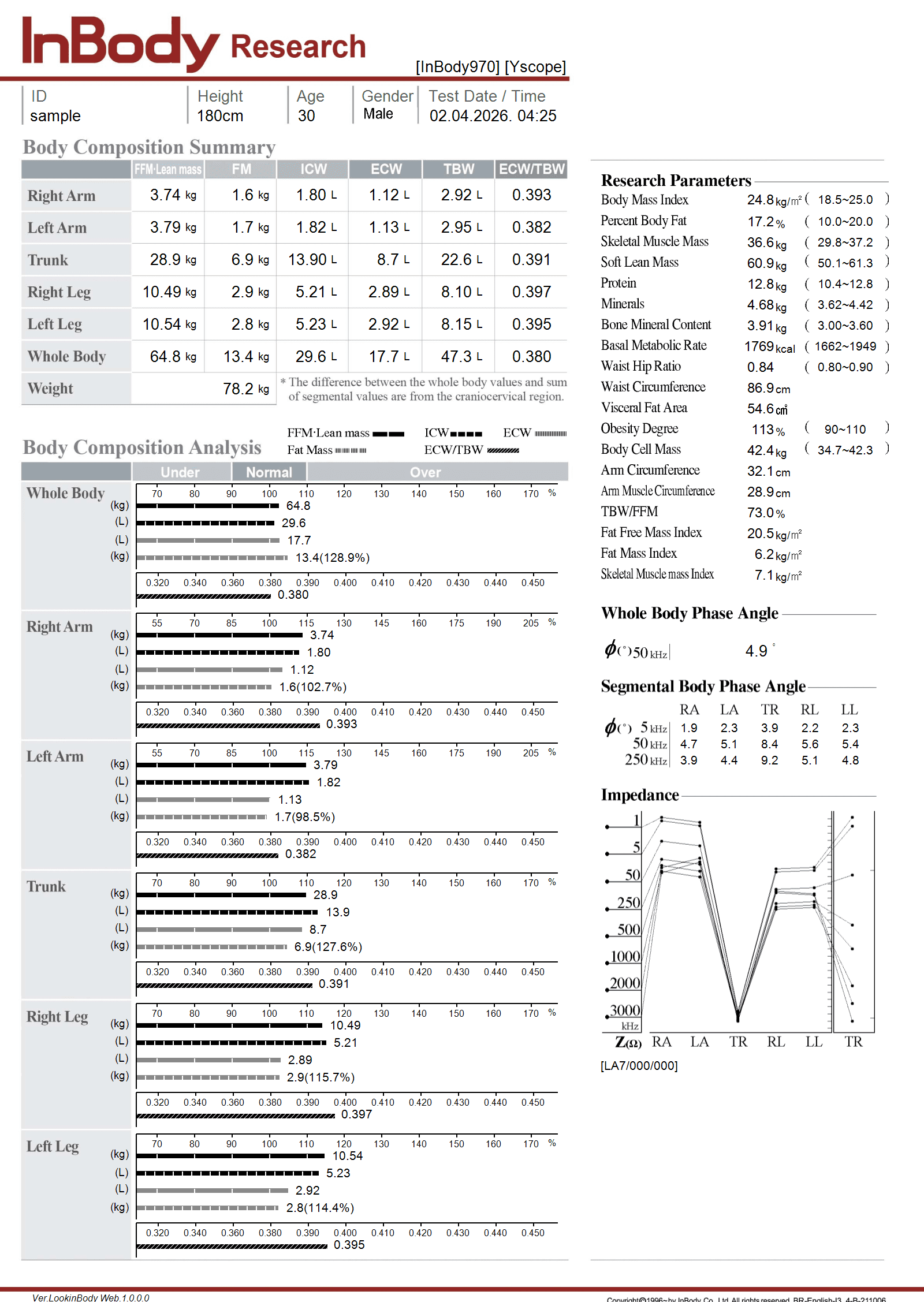
Research Result Sheet
A comprehensive parameter summary across all segments including phase angle at three frequencies (5 kHz, 50 kHz, 250 kHz), impedance values at every frequency, body cell mass, protein, minerals, bone mineral content, and BIVA graphing.
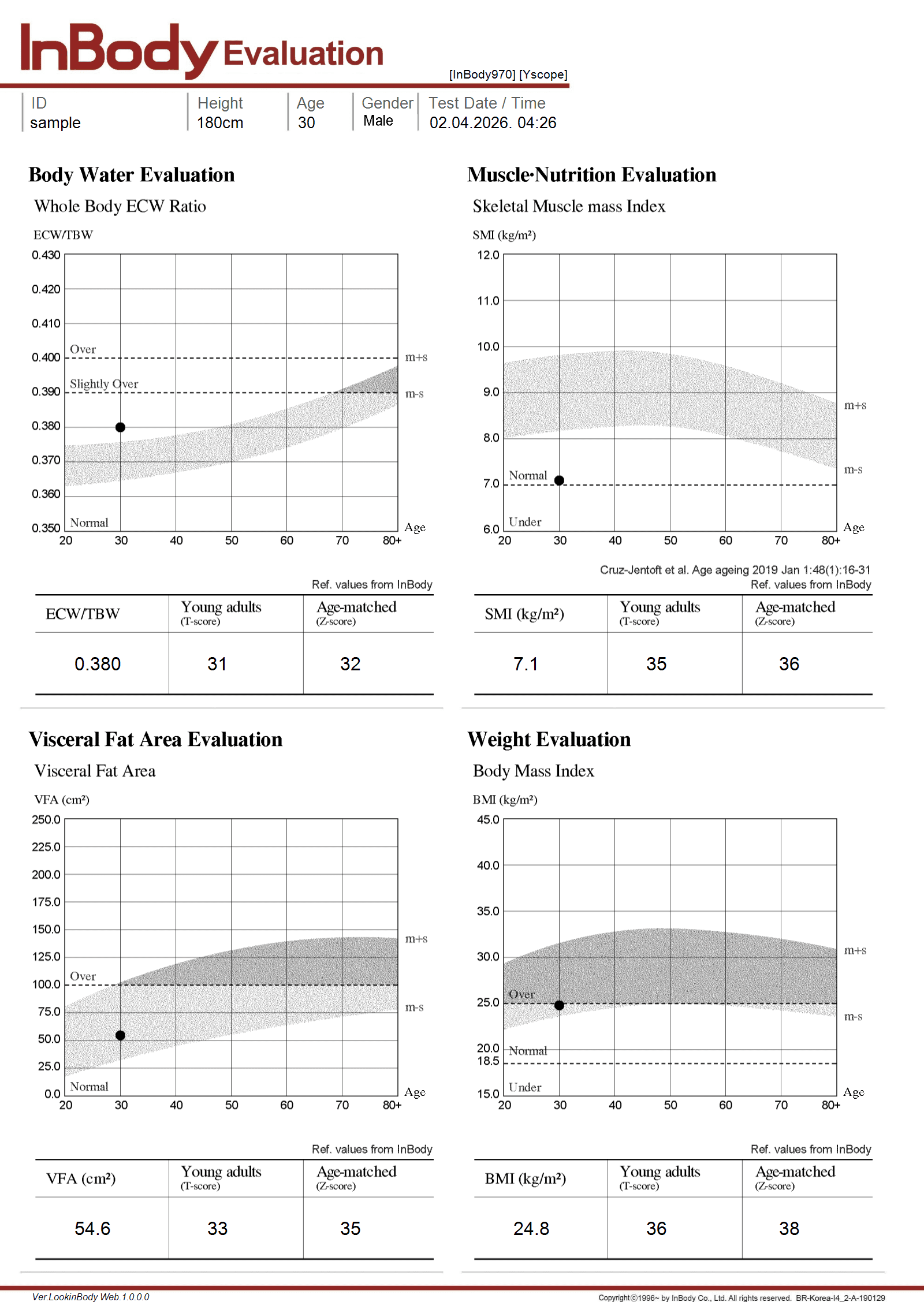
Evaluation Result Sheet
Your results benchmarked against over 150 million InBody data points globally, with T-scores (compared to young adults) and Z-scores (compared to your age group) across key parameters including skeletal muscle index, ECW ratio, visceral fat area, BMI, and phase angle.
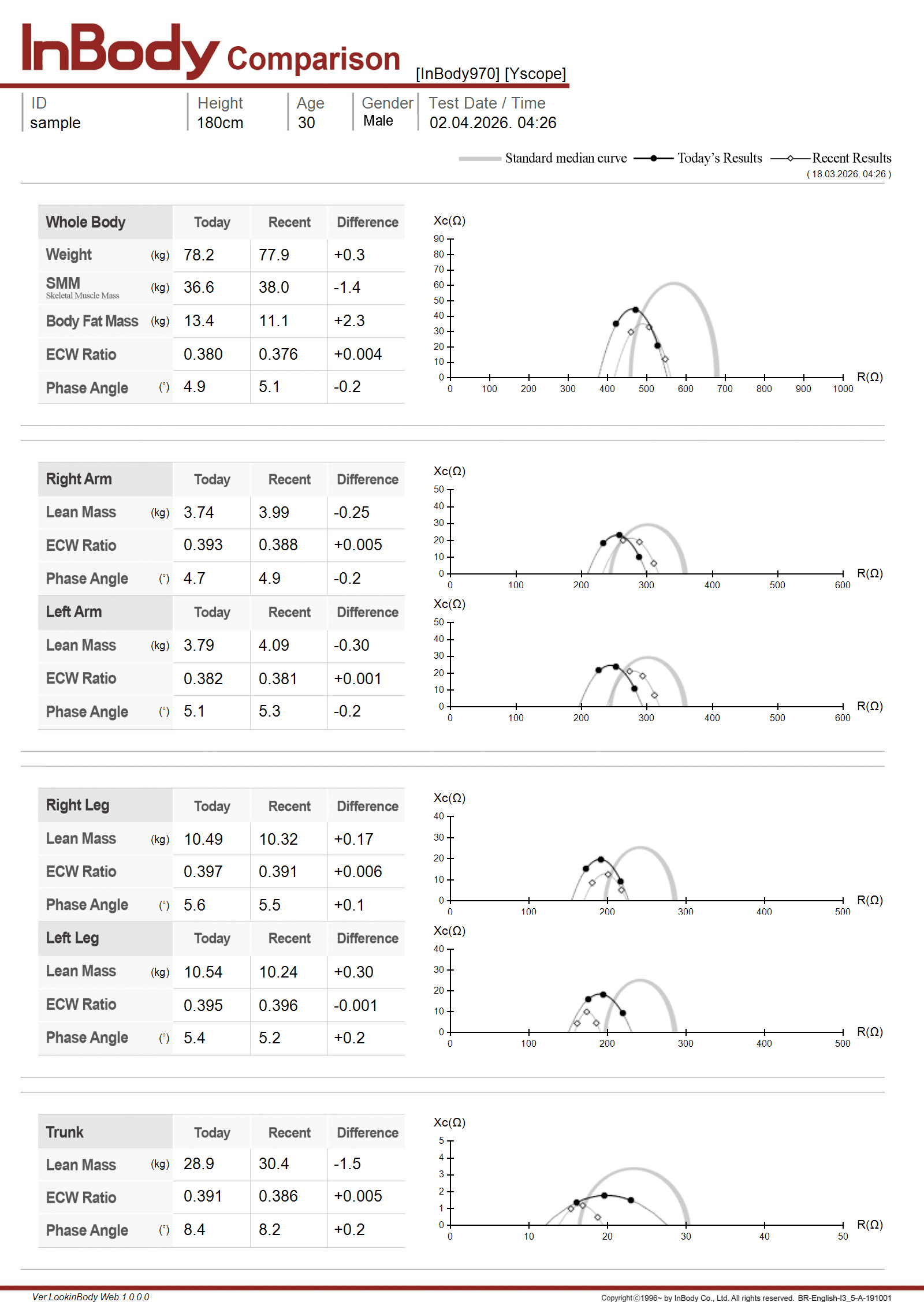
Comparison Result Sheet
A side-by-side view of two scans with Cole-Cole plot graphs, allowing direct before-and-after comparison on a single page.
Children's Result Sheet
Designed for paediatric assessment, this report tracks growth and physical development against standard curves, with growth graphs for height and weight, nutrition evaluation, obesity evaluation, body balance assessment, and segmental analysis. It gives parents, paediatricians, and sports coaches a clear picture of how a child is developing, grounded in data rather than guesswork.
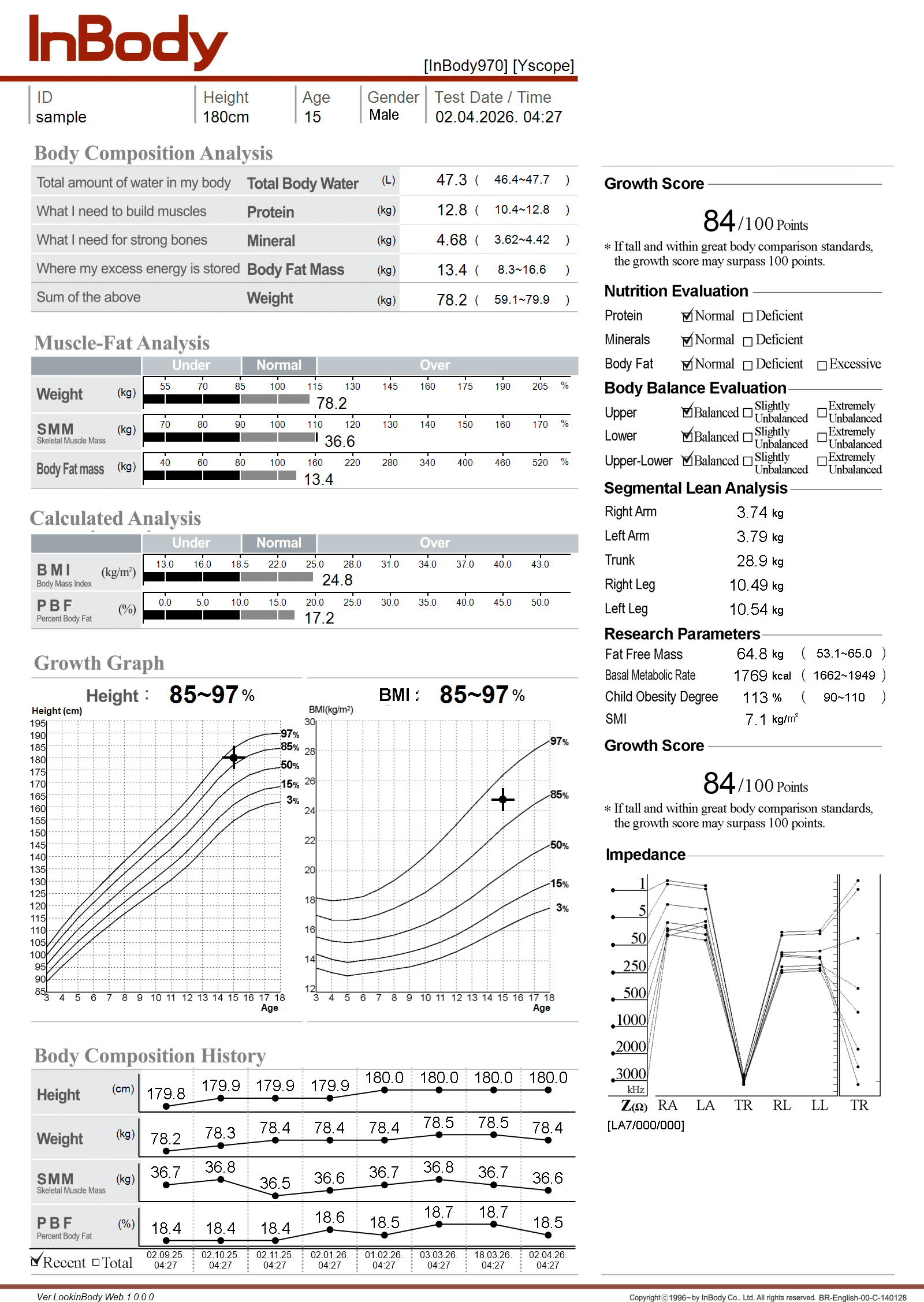
WHO Uses the InBody 970?
The InBody 970 is the body composition tool of choice for organisations that need data they can act on.
NASA’s Johnson Space Center replaced its previous body composition tools with InBody to power its Starport employee wellness program. The U.S. Army authorised the InBody 770 (the less advanced ‘cousin’ of our 970 model) as an official supplemental body fat assessment method under Army Directive 2023-11, and uses BIA throughout its Holistic Health and Fitness (H2F) system. The NHS uses InBody across clinical settings in the United Kingdom (and many medical settings globally, are following suit). InBody devices are used by elite sporting teams, weight loss clinics, research universities, rehabilitation centres, and medical practices in over 110 countries.
These organisations did not choose InBody because it was convenient (though it is). They chose it because it gives them clinical-grade data that is accurate, reproducible, and practical enough to use for regular ongoing monitoring. That last point is critical. DEXA scans involve radiation, require a medical referral, cost upwards of $200 per scan, and are impractical for frequent testing. The InBody 970 delivers comparable precision in 70 seconds with no radiation, which is why the world’s most demanding organisations have moved to it for routine body composition assessment.
The InBody 970 at Get Scanned
Get Scanned operates the InBody 970 across Melbourne, and Regional Victoria via a purpose-built mobile scanning vehicle: the Scan-Van. This is the only service of its kind in Australia.
The Scan-Van travels to our host gyms, fitness studios, medical clinics, corporate workplaces, and community events on a regular schedule. If there is no clinic near you, we bring the Scan-Van directly to your door.
Every scan includes comprehensive, intelligent and insightful education with Get Scanned’s very own ‘Scan-Man’, Steve, covering what your data means, how it compares to your previous scans, and what you can do with it. This is not a self-service kiosk experience. It is a professional consultation built around the most detailed body composition data available outside a hospital.
Your first appointment takes approximately 20 to 30 minutes. Follow-up scans take 10 to 15 minutes.
InBody 970 FAQ
Over 70 parameters including skeletal muscle mass, body fat mass, percent body fat, visceral fat area, total body water, intracellular and extracellular water, segmental lean and fat analysis for each arm, leg, and trunk, phase angle, body cell mass, basal metabolic rate, and more. You receive a multi-page printed report immediately after your scan.
InBody technology has been validated in over 8,000 peer-reviewed studies. Correlation to DEXA for lean body mass has been measured at up to 99% in published research. The InBody 970 delivers 99% test-retest reproducibility, meaning you can trust that changes between scans reflect real changes in your body.
Not even close. Those devices typically use 1 to 3 frequencies (and use them improperly), measure only your legs or only your arms, treat your entire body as a single cylinder, and plug your age and gender (and sometimes even 'activity level') into a statistical equation to loosely estimate everything they didn't actually measure. Change your age or gender in the settings and you'll get a different result - often vastly different. That should tell you everything you need to know about what's being "measured." The InBody 970 uses 8 frequencies across 5 independently measured body segments, takes 40 impedance measurements in 70 seconds, and uses ZERO empirical estimations whatsoever. Your results come from your body, not a formula.
DEXA uses low-dose X-ray radiation, requires a hospital or clinic visit, takes 10 to 15 minutes lying down, and typically costs $150-$200 or more. The InBody 970 uses bioelectrical impedance with no radiation, takes 70 seconds standing up, and can be repeated as often as needed. For regular monitoring of body composition changes over time, InBody is the practical choice, which is why NASA, the U.S. military, and thousands of medical and research facilities worldwide have adopted it.
Yes. The InBody 970 uses safe, low-level electrical currents that are completely imperceptible. There is no radiation of any kind. The only exception is people with implanted electronic medical devices such as pacemakers, who should not be tested without medical clearance. Metallic implants like joint replacements or stents are not affected.
For most people tracking body composition changes from training or nutrition, every 4 to 8 weeks is ideal. More frequent scanning is useful during intensive programs or medical monitoring. Because there is no radiation, there is no limit on how often you can test.
Avoid eating for 2 to 3 hours, avoid strenuous exercise and hot/cold therapies or activities for 2 to 3 hours before your scan. Use the bathroom beforehand. Wear light clothing. Remove jewellery, socks, and shoes before stepping on the device. Full details are available on our page Preparing for InBody.
No. All Get Scanned clinics are open to everyone. You do not need a membership at the host venue, a medical referral, or any prior relationship with us. Just book and show up (limited walk-in availability may also be available on the day, but we always recommend you book in to avoid disappointment and to ensure you get the right pre-scan preparation protocol advice and reminders).
InBody 970 Overview
What the InBody 970 is
The InBody 970 is InBody's flagship medical-grade body composition analyser, built by the South Korean biomedical company InBody. It is a standing bioelectrical impedance device that produces over 70 clinical parameters in a 70 second scan with no radiation and no undressing. Measured outputs include skeletal muscle mass, body fat mass, total body water split into intracellular and extracellular, visceral fat area, segmental lean and fat distribution, phase angle and body cell mass.
How it works
Four things separate it from other bioelectrical impedance devices. It measures all five body segments independently, including the trunk, which holds roughly half of lean body mass and which most competitors cannot measure. An eight-point tactile electrode system with patented thumb contacts starts every measurement at the same anatomical point, giving 99 percent test-retest reproducibility. It uses eight frequencies from 1 kHz to 3 MHz, taking 40 impedance measurements per scan, with 3 MHz enabling precise separation of intracellular and extracellular water. And it uses no empirical estimations: results are calculated from measured impedance rather than from population assumptions based on age, sex or ethnicity.
What medical-grade means here
The InBody 970 is FDA cleared, CE marked, TGA listed and certified to ISO standards. It has been validated against DEXA in peer-reviewed studies with correlation up to 99 percent for lean body mass, and delivers 99 percent reproducibility between tests. Consumer bioelectrical impedance scales typically use one or two frequencies, measure the legs or arms only, treat the body as a single cylinder, and apply age and gender equations to fill gaps. Changing the age entered into such a device changes the result. On the InBody 970 it does not, because composition is measured rather than estimated.
What each scan produces
Every scan produces a multi-page clinical report. Get Scanned always includes the Body Composition and Body Water result sheets. Body Composition covers lean and fat mass, skeletal muscle mass, percent body fat, segmental lean and fat analysis for each limb and the trunk, visceral fat area, basal metabolic rate and history over time. Body Water covers intracellular and extracellular water with segmental analysis, and the ECW to TBW ratio used to identify fluid imbalance, inflammation and oedema. Research, Evaluation, Comparison and Children's result sheets are available when needed, covering phase angle at three frequencies, benchmarking against global reference data with T-scores and Z-scores, side-by-side scan comparison, and paediatric growth and development tracking.
Who uses it
InBody devices are used in over 110 countries by elite sporting teams, research universities, rehabilitation centres, weight loss clinics and medical practices. NASA's Johnson Space Center uses InBody for its Starport employee wellness program. The US Army authorised the InBody 770 as a supplemental body fat assessment method under Army Directive 2023-11. The NHS uses InBody across clinical settings in the United Kingdom. The practical reason is repeatability: DEXA involves radiation, requires a referral, and is impractical for frequent testing, while the InBody 970 delivers comparable precision in 70 seconds with no radiation. At Get Scanned every scan is run and interpreted by Steve Burden, a health coach with over 28 years in the health care and fitness industries, and the scan is delivered as a full education and coaching session rather than just handing clients a printout.
How Get Scanned delivers it
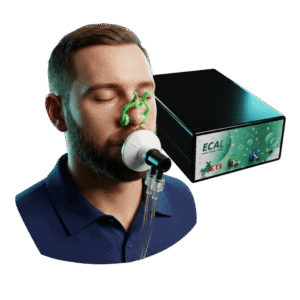
Get Scanned operates the InBody 970 across Greater Melbourne and regional Victoria from a purpose-built mobile scanning vehicle, the Scan-Van. It is the only mobile InBody 970 service in Australia, and the only mobile service offering bioelectrical impedance analysis together with ECAL indirect calorimetry. Other mobile operators carry portable folding analysers and set them up in public spaces. Get Scanned runs a fitted clinic vehicle with the full equipment installed, which is what allows the geographic range it covers. The Scan-Van travels to host gyms, fitness studios, medical clinics, corporate workplaces and community events on a regular schedule, and can be requested directly to an address where no clinic is nearby.